Off-Plan vs Resale in Israel: The Foreign Buyer's Decision Framework
Off-plan locks today's price and defers roughly 70 percent of payment to delivery, but exposes the buyer to Madad construction-index inflation and developer-completion risk (mitigated by mandatory Arvut Bankit Bank Guarantee). Resale eliminates construction risk and starts rental income immediately, but requires the full 50 percent LTV mortgage at signing. Mas Rechisha brackets (8 to 10 percent for foreign buyers) are identical for both.
Two paths to Israeli ownership, two very different financial profiles. A complete comparison covering tax, capital deployment, risk, timeline, and the structural differences your home-country instincts won't prepare you for.

The Island, Bat Yam, Kardan Real Estate's landmark twin towers at Park HaYam. This is the off-plan asset class: cutting-edge architecture, Mediterranean coastline, and a construction timeline that lets buyers deploy capital in stages.
Key Takeaways
- Off-plan and resale are not the same investment with different timelines, they are structurally different financial products with different tax exposures, financing dynamics, and risk profiles.
- Off-plan typically requires 20-40% upfront with the balance due 3-5 years later, capturing appreciation during construction; resale requires 50% upfront on a 50% LTV mortgage with immediate occupancy.
- The Mas Rechisha purchase tax for foreign buyers is identical for both, 8% to 10%, but the timing differs. Off-plan purchases also carry Madad (Construction Input Index) exposure that resale does not.
- Off-plan capital is protected by a statutory Bank Guarantee covering 100% of payments. Resale carries no equivalent protection but eliminates developer-completion risk entirely.
- Most diaspora buyers should consider both. The right answer depends on your time horizon, capital deployment preferences, currency exposure tolerance, and whether you want to live in the apartment in the next twelve months.
There is no single right answer to the off-plan versus resale question, and the agents who tell you otherwise are usually selling whichever one they have inventory for. The honest answer is that both paths produce successful Israeli ownership outcomes for international buyers, and the decision turns on five variables you can model in advance.
I have guided clients into both structures from New York, London, Toronto, Paris, and Sydney. The pattern I see is consistent: buyers who understand the structural differences before they fall in love with a specific property make the right choice. Buyers who reverse the order, finding the apartment first, then trying to retrofit a financial structure, usually end up overpaying for the wrong fit.
This guide walks through the five variables that determine the answer, and then gives you a side-by-side comparison so you can see how the math actually works on a representative purchase.
What Off-Plan and Resale Actually Mean in Israel
Off-plan, known in Israel as al ha-niyar ("on paper"), is the purchase of an apartment in a development that has not yet been completed. The building may be at any stage from pre-launch (no construction yet, just renderings and a sales gallery) through advanced construction (foundation laid, towers rising). You sign a contract committing to the purchase, pay a structured down payment, and the developer delivers the finished apartment two to five years later. The market for off-plan inventory in Israel is large; in 2025, off-plan transactions accounted for roughly 30 percent of all residential purchases nationally and a significantly higher share at the luxury end.
Resale, known as yad shniya ("second hand"), is the purchase of a finished, occupied or vacant apartment from its current owner. The contract structure is simpler: you sign, you pay, and you receive the keys typically within 60 to 90 days. There is no developer, no construction risk, and no waiting. What you see is what you buy.
Both structures are governed by Israeli real estate law and both require an attorney-led process. Both incur the same Mas Rechisha purchase tax for foreign buyers (8% on the first ₪6,055,070 and 10% above, frozen at these brackets through end of 2026, verify the current threshold with your Israeli attorney at signing). Both require Tabu registration. The differences are in everything else.
The Five Variables That Decide the Answer
Variable 1: Your time horizon
When do you actually want to use the apartment? If the answer is "within the next twelve months", for a child's gap year in Israel, an upcoming Aliyah, or immediate rental income, resale is your only realistic path. Off-plan delivery timelines run three to five years from contract signing for projects launched today, and that timeline has become more reliable in 2026 than it was during the pandemic but is still measured in years, not months.
If your timeline is three to seven years out, purchasing for a teenager who will study in Israel after university, planning Aliyah for the next decade, or simply wanting to position capital in an Israeli asset that compounds without immediate use, off-plan is structurally aligned with your needs. The construction window becomes your appreciation window.
Variable 2: Your capital deployment preference
On a finished resale apartment, foreign buyers typically deploy 50 percent of the purchase price in cash at closing, plus closing costs of roughly 12 to 14 percent. On a ₪3 million apartment, that is ₪1.5 million cash plus another ₪400,000 in closing costs, ₪1.9 million committed within 90 days.
On an off-plan purchase under a typical 30/70 or 40/60 plan in 2026, you deploy 30 to 40 percent of the purchase price plus closing costs at signing, with the remaining 60 to 70 percent due at delivery three to five years later. On the same ₪3 million apartment, that is ₪900,000 to ₪1.2 million committed at signing, with the balance financed or paid from accumulated capital at delivery. Your total cash deployment over the life of the purchase is similar; the question is when.
Buyers with capital that is currently working hard elsewhere, a private equity fund position, a successful business operation, a high-yield investment portfolio, typically prefer off-plan because their deferred capital continues to compound during construction. Buyers sitting on idle cash typically prefer resale because the simplicity is worth more than the deferral benefit.
Variable 3: Your currency exposure tolerance
This is the variable that catches most diaspora buyers off guard. Israeli property is priced in shekels. Off-plan contracts denominate the deferred balance in shekels too, with the Madad (Construction Input Index) layered on top of that balance during the build cycle. If the shekel strengthens against your home currency over the construction period, as it has done dramatically in 2024 and 2025, reaching 30-year highs, your final payment becomes meaningfully more expensive in dollar, pound, euro, or Canadian-dollar terms.
Resale eliminates this risk because you settle the entire purchase price at closing. Off-plan retains it for the duration of construction - which is why many of our clients structure off-plan purchases with parallel currency hedging or a shekel-denominated mortgage at closing to neutralize the FX exposure on the deferred balance.
Variable 4: Your appetite for completion risk
Off-plan introduces a risk category that resale does not have: the possibility that the developer fails to complete the building. This risk is mitigated, extensively, by Israel's Sale Law (Chok HaMecher), which mandates a Bank Guarantee (Arvut Bankit) covering 100 percent of buyer payments against developer insolvency. Combined with bank accompaniment (Livui Bankai), under which the lending bank supervises construction and releases funds against verified milestones, the structural protection is significant.
But statutory protection is not the same as zero risk. Construction delays are common in Israel; we routinely see projects deliver six to twelve months later than the contract date. Israeli law gives the developer a 60-day grace period and then triggers statutory delay compensation at 1.5x equivalent rental value for the next eight months and 1.25x thereafter, so buyers are economically protected against delay, but not against the inconvenience of waiting longer than planned. Resale buyers do not encounter this category of risk at all.
Variable 5: Your appreciation thesis
Off-plan buyers are betting that Israeli property appreciates during the construction window. Over the past decade, this bet has paid off consistently, Tel Aviv prime property prices have approximately doubled, Jerusalem and Netanya have appreciated meaningfully, and the construction window has functioned as a de facto leverage instrument. A buyer who locked in a 2021 price and took delivery in 2025 captured the entire 2021-2025 price trajectory while only deploying 20 to 30 percent of their capital during that period.
Resale buyers also benefit from appreciation, but only on the capital they have actually deployed. The leverage effect is absent. Conversely, if Israeli property prices stagnate or correct during a particular construction window, which has happened during specific periods, including parts of 2008-2010, off-plan buyers would have been better off in resale.
Our base case for 2026-2030 is continued moderate appreciation in Tel Aviv prime, Jerusalem prime, and the coastal corridor, driven by structural supply scarcity, surging diaspora demand, and a recovering rate environment. But we make this case to clients with appropriate epistemic humility; we are not in the business of certainty, only of structural analysis.
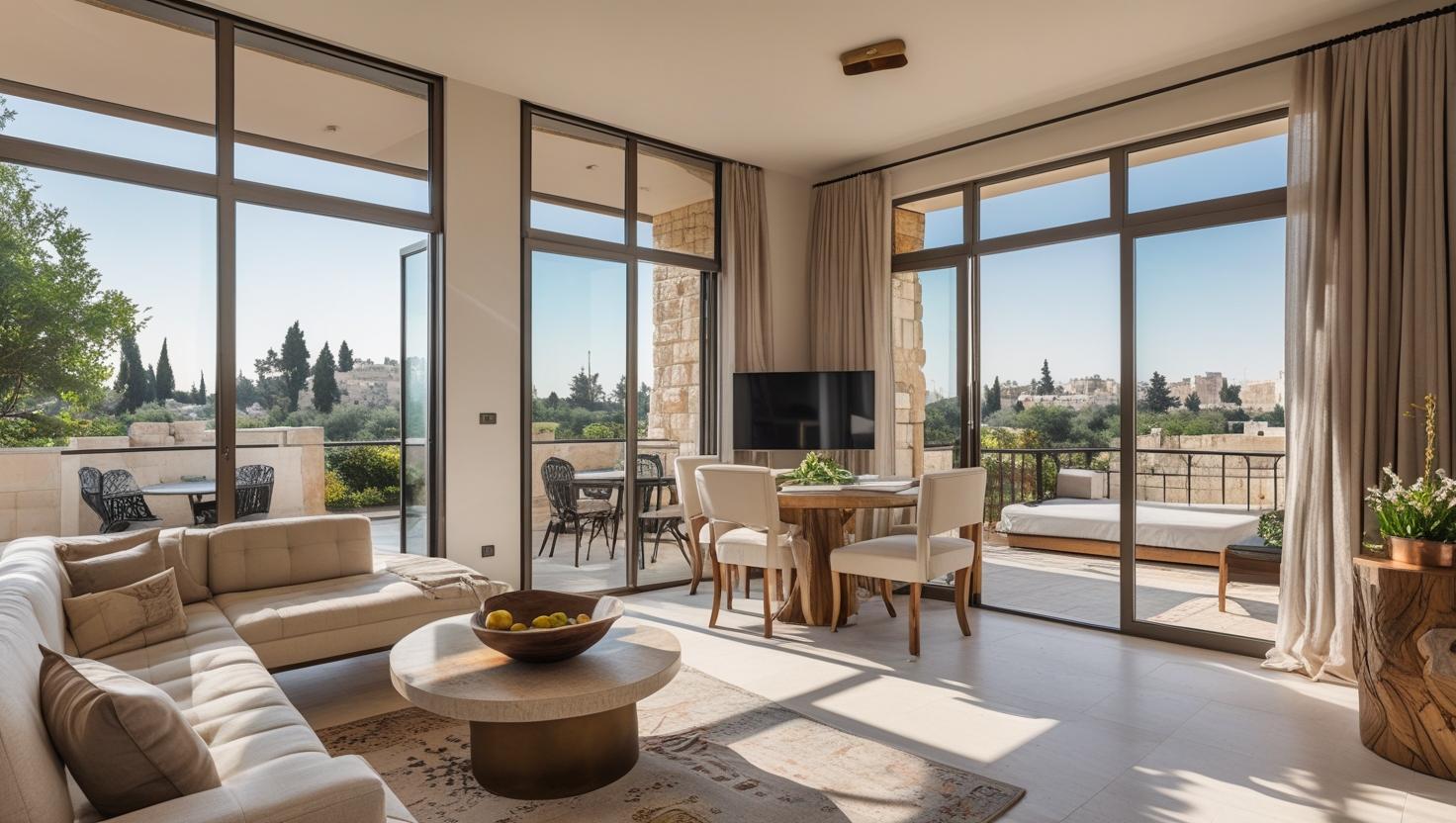
A finished interior at Midtown Jerusalem. Off-plan buyers see renderings of spaces like this; resale buyers walk through them. Both paths can deliver the same end-state asset; the journey, the financing, and the risk profile differ entirely.
Side-by-Side: A Representative ₪3M Purchase
Let us run the numbers on a concrete example. You are a US-based buyer evaluating a ₪3,000,000 apartment in central Tel Aviv. The same apartment is available as a finished resale and as an off-plan unit in a comparable building under construction. Here is how the two scenarios actually play out.
| Variable | Off-Plan (40/60 split, 36-month build) | Resale (immediate closing) |
|---|---|---|
| Purchase price | ₪3,000,000 | ₪3,000,000 |
| Cash at signing | ₪1,200,000 (40%) | ₪1,500,000 (50%) |
| Cash at closing/delivery | ₪0 (financed) or up to ₪1,800,000 | ₪0, already paid |
| Mortgage available | Up to 50% LTV at delivery | Up to 50% LTV at closing |
| Mas Rechisha (8%) | ₪240,000, within 60 days of signing | ₪240,000, within 60 days of signing |
| Lawyer fees | ~₪35,000 (1% + VAT) | ~₪35,000 (1% + VAT) |
| Madad exposure | ~₪150,000,₪400,000 over 36 months | None |
| Time to occupancy | 36-60 months | 60-90 days |
| Developer/seller risk | Mitigated by Arvut Bankit | Standard title risk only |
| Currency risk on deferred sums | Yes, 60% balance for 36 months | None |
| Appreciation captured during build | Yes, on full ₪3M asset | Yes, only on equity, not full price |
| Total cash deployed (no mortgage) | ₪3,000,000 over 3+ years | ₪3,000,000 within 90 days |
The off-plan path defers ₪300,000 of initial capital and adds ₪150,000 to ₪400,000 in Madad exposure on the deferred balance. The resale path requires ₪300,000 more upfront but eliminates Madad, currency risk on the deferred amount, and completion risk entirely. The two paths reach the same ownership state via genuinely different financial routes.
If you cannot decide based on the variables above, ask yourself this: which scenario keeps you up at night more, paying ₪300,000 more upfront and waking up tomorrow with a finished apartment, or paying ₪300,000 less upfront and waiting three years while your deferred balance moves with the shekel and the Madad? Most buyers, when they sit with the question honestly, know their answer within thirty seconds.
Where Off-Plan Wins
Off-plan is the structurally superior choice for buyers with at least four characteristics. First, a time horizon of three or more years before they need the apartment for personal use or rental income. Second, capital that is currently productive elsewhere and would be opportunistically deployed into Israeli real estate rather than urgently. Third, comfort with multi-year currency and Madad exposure, ideally with a hedging plan or shekel-mortgage strategy in place. Fourth, an appreciation thesis they are willing to underwrite, believing that Tel Aviv, Jerusalem, or the coastal corridor will be priced higher in 2029 than today.
Off-plan also wins when you want to own a specific kind of new construction that simply does not exist in the resale market. Israel's most ambitious luxury developments, Rainbow Tel Aviv at Sde Dov, Midtown Jerusalem, the U Towers and Island in Bat Yam, are off-plan inventory by definition. There is no finished version of these buildings. If you want to own at this caliber of architecture, amenity, and address, off-plan is the only path.
Where Resale Wins
Resale is the structurally superior choice when occupancy is needed quickly, when the buyer prefers simplicity over leverage, when currency or Madad risk is unacceptable, or when the specific neighborhood the buyer wants, particularly the most established prime addresses in Jerusalem (the German Colony, Talbiya, Rehavia) and the historic core of Tel Aviv (Neve Tzedek, the Old North), has very limited new construction available.
Resale also wins when the buyer is making a high-conviction, single-asset purchase rather than a diversified investment. A grandparent buying a Jerusalem apartment so adult children and grandchildren can spend Pesach and Sukkot in Israel does not particularly want to defer that purchase by three years. A Floridian retiree relocating gradually to Netanya wants the keys this year, not in 2029. Resale is for buyers whose use case is now.
The Hybrid Path Most Buyers Don't Consider
There is a third option that experienced diaspora buyers increasingly choose: own both. A resale apartment for immediate use, as a pied-à-terre, a child's apartment in Israel, or an income-producing rental, combined with an off-plan position in a flagship development for capital appreciation and longer-term ownership. The two structures are complementary. The resale apartment delivers the lifestyle and family-connection benefits of Israeli ownership immediately; the off-plan position positions capital for the next ownership chapter.
We work with several clients who have built portfolios this way: one resale unit acquired in 2022 in Jerusalem's German Colony, an off-plan position taken in 2024 at Rainbow Tel Aviv, and possibly a third position in Netanya or Bat Yam under consideration. The total capital commitment is meaningful but the structural risk is diversified across both timelines and geographies, and the diaspora-ownership thesis compounds across multiple assets rather than concentrating in one.
How to Decide
Run the five-variable analysis honestly. Time horizon, capital deployment preference, currency tolerance, completion-risk appetite, appreciation thesis. If three or more variables point clearly to off-plan, off-plan is your answer. If three or more point clearly to resale, that is your answer. If they split evenly, which happens often, the tiebreaker is usually the question we asked above: which scenario keeps you up at night more?
We are agnostic about the answer for any individual client. Ascend's portfolio includes both off-plan flagship developments (Rainbow, Midtown, Esther, Island, U Towers) and curated resale opportunities through our buyer-side acquisition service. The right answer for any given buyer is the one that fits their actual circumstances, not the one that fits the agent's inventory. That is why we built the firm the way we did, attorney-led, fee-aligned with the buyer rather than the seller, and structurally indifferent between paths.
If you would like to walk through your specific situation against the five-variable framework, that is what an initial consultation is for. There is no obligation, no soft-close, no pressure to commit to either path. The decision is yours; our role is to make sure you are making it with full information.
Frequently Asked Questions
The leverage benefit of off-plan is genuine: deploying 30 to 40 percent of the purchase price upfront while controlling 100 percent of the asset's appreciation potential is structurally attractive. But the benefit is not free. Off-plan exposes the buyer to the Construction Input Index on the deferred balance, currency volatility for the duration of the build, and the inconvenience risk of construction delays. For buyers with capital working productively elsewhere and a 3+ year horizon, the leverage benefit usually outweighs the costs. For buyers sitting on idle cash who want immediate occupancy or rental income, resale is structurally cleaner.
The purchase tax structure is identical: 8 percent on the first ₪6,055,070 and 10 percent above for foreign buyers, frozen at these brackets through the end of 2026. The only difference is timing. For both off-plan and resale, the tax is owed within 60 days of signing the purchase contract, even though for off-plan the apartment will not be delivered for several more years. This catches some buyers off guard, they expect to defer the tax payment alongside the deferred purchase price, but the Israeli Tax Authority does not allow this. Budget for the full Mas Rechisha to be paid early in either path.
The off-plan contract locks in the purchase price at signing. If Tel Aviv prices fall 10 percent during your 36-month construction window, you are still obligated to pay the original price. Conversely, if prices rise 20 percent, you also pay the original price. The locked-in price is a feature for rising markets and a bug for falling markets. Israeli law does not provide a mechanism for buyers to renegotiate based on market movement, only for material breaches by the developer (significant delays, scope changes, or insolvency triggering the Bank Guarantee). This is why an honest appreciation thesis matters. Off-plan amplifies whichever direction the market moves.
Israeli banks lend to foreign buyers on both off-plan and resale at a maximum 50 percent loan-to-value ratio. The major lenders for non-residents are Mizrahi-Tefahot, Bank Leumi, and Israel Discount Bank. Current rates run 4.5 to 6.5 percent depending on track and term. For resale, the mortgage funds at closing, which is typically 60 to 90 days after signing. For off-plan, the mortgage is arranged closer to delivery - which means three to five years after signing. Some buyers prefer this delay because they assume rates will be lower at delivery; others find the uncertainty uncomfortable. Mortgage pre-qualification before contract signing is essential in both cases because Israeli contracts contain no mortgage contingency clause, financing failure post-signing forfeits your deposit.
The Construction Input Index (Madad) tracks the cost of construction inputs in Israel, materials, labor, subcontractor costs. Off-plan contracts in Israel typically index the deferred balance to the Madad from contract signing through delivery, so the buyer absorbs construction cost inflation that occurs during the build. Over the past decade the Madad has averaged 2 to 4 percent annually, occasionally spiking higher during global supply shocks. On a typical 36-month build, expect a cumulative 6 to 12 percent addition to your deferred balance. On a ₪3 million purchase with a ₪1.8 million deferred balance, that is roughly ₪110,000 to ₪220,000 in additional cost. Some developers offer Madad caps or structured indexation to reduce this exposure; we negotiate these terms aggressively for our clients.
Off-plan contracts in Israel can usually be assigned to a third-party buyer before delivery, allowing the original buyer to exit and capture any appreciation that occurred between signing and assignment. The developer typically must approve the assignment and may charge an assignment fee of 1 to 2 percent of the purchase price. This creates a meaningful secondary market, particularly for buyers whose circumstances change during the construction window. Some buyers consciously enter off-plan positions with assignment in mind, treating the contractual position as a tradeable asset. The Mas Rechisha is owed by the original buyer at signing, and the assignee then pays their own Mas Rechisha when they take title. Tax planning around assignment is a topic we walk through with any client considering this approach.
Quality delivery is the implicit assumption of the off-plan model and the area where buyers face the most variance in outcomes. With Israel's largest publicly-listed developers, Israel Canada, Kardan Real Estate, Aura Investments, Africa Israel, the gap between rendering and delivered reality is generally narrow, with finishes and amenities matching contractual specifications. With smaller private developers, the variance is wider and occasional disputes arise over substituted materials, scaled-back amenities, or unfinished common areas. This is why Ascend's portfolio focuses exclusively on Tier-1 developers with multi-decade track records and TASE-listed accountability. The contract should also include detailed finish specifications (the mifrat tochni) which becomes the binding reference at delivery.
If rental income is your primary objective, resale is structurally superior because income generation begins at closing rather than three to five years later. On a 10-year hold, a resale apartment generates 10 years of rental income; an off-plan apartment with a 4-year build generates only 6 years. At a 3.5 percent gross yield on a ₪3 million property, the difference is ₪420,000 in foregone rental income, not trivial. Off-plan's advantage in this comparison is appreciation captured during the build, which can offset the foregone income but typically does not exceed it for buyers with primarily yield-oriented objectives. For buyers prioritizing total return over yield specifically, the two paths are closer.
Buy-and-renovate is a path some buyers consider, acquire a resale apartment in a desirable neighborhood, then bring the finish quality up to new-construction standards. The math rarely works in 2026 for several reasons. Renovation costs in Israel have risen sharply, running ₪3,500 to ₪6,000 per square meter for a comprehensive renovation. On a 100-square-meter apartment, that is ₪350,000 to ₪600,000, roughly the cost of a new-construction premium per unit. The renovation timeline is six to twelve months, during which the property generates no income. And renovating in Israel from abroad introduces significant project-management complexity. Buy-and-renovate works best for buyers who want very specific architectural outcomes that off-plan developers are not delivering, or who value the bones of an older building in a neighborhood where new construction is impossible (the Bauhaus core of Tel Aviv, parts of historic Jerusalem).
Have questions about your specific situation?
Ascend Israel Properties guides international buyers from the US, Canada, UK, Australia, and Europe through every stage of the Israeli property acquisition process, legal, financial, and logistical.
Schedule a ConsultationSources & References
Israel Central Bureau of Statistics (residential transaction data, Q2 2025) · Israel Tax Authority (Mas Rechisha brackets, 2025-2026 freeze) · Bank of Israel (mortgage regulation and rate data, March 2025 LTV restrictions) · Global Property Guide Israel (Q2 2025 city price history) · Israel Ministry of Justice, Land Registry (Tabu) proceduresLegal Disclaimer. This article is provided for informational purposes only and does not constitute legal, tax, or investment advice. Real estate decisions involve complex legal, financial, and personal factors that vary by jurisdiction and individual circumstance. Tax codes, regulatory frameworks, and market conditions change. Before signing any purchase contract or making any financial commitment, consult with a qualified Israeli real estate attorney and a dual-jurisdiction tax adviser experienced with international property transactions. Ascend Israel Properties and the author do not assume liability for the accuracy or completeness of information contained herein or for any actions taken in reliance on this article. Information current as of April 26, 2026.