
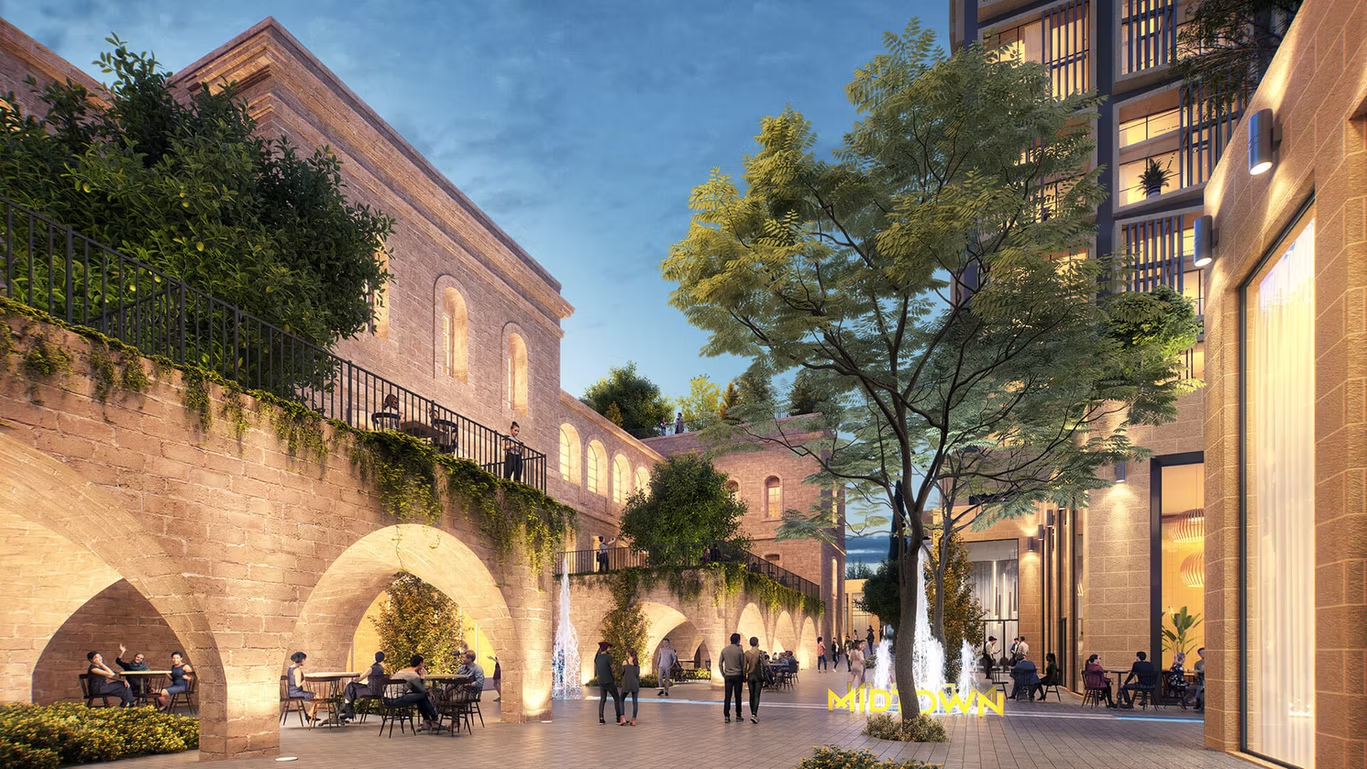
A Silicon Valley technology executive purchased a six-room Bauhaus villa in Rehavia—Jerusalem's most prestigious neighborhood—for ₪22 million ($6.5 million) in late 2025. His Tel Aviv broker was baffled. Comparable Tel Aviv beachfront penthouses carried asking prices of ₪28-32 million. Why Jerusalem? Because he wasn't buying a 3-year flip. He was buying for 2050.
The Tel Aviv Mirage: Oversupply Meets Reality
Tel Aviv's luxury market has become the consensus trade. Foreign investors, returning diaspora, and local wealth have flooded the coastal capital, pushing luxury prices to unprecedented levels. Median prices in prime neighborhoods reached ₪4.37 million ($1.29 million) in 2025, with some Rothschild Boulevard penthouses trading above ₪95,000 per square meter.
Yet beneath the surface lies structural weakness. Approximately 15,000 luxury units sit under construction, predominantly in high-rise developments concentrated in Tel Aviv's Tower District. Brokers describe an emerging bifurcation: penthouses in preservation-restricted historic areas hold pricing power, while tower developments face mounting inventory pressure. Two mid-sized developers entered receivership in 2025 as labor shortages extended timelines and costs spiraled.
For investors with long-term horizons, Tel Aviv's current market structure presents a timing challenge: foreign demand may have peaked, new supply is accelerating, and local affordability metrics are deteriorating. The market is optimized for 3-5 year hold periods with outsized capital appreciation—not generational wealth anchors.
Jerusalem's Hidden Aristocracy: Four Neighborhoods Worth Understanding
While Tel Aviv captured headlines, Jerusalem quietly developed a parallel ecosystem of ultra-premium neighborhoods. Unlike Tel Aviv's density and glass towers, Jerusalem's luxury exists in preserved stone villas, tree-lined streets, and walkable intellectual communities.
Rehavia. Jerusalem's Harvard Square. Populated by Supreme Court justices, university presidents, senior government officials, and international academics, Rehavia represents institutional concentration unmatched anywhere in Israel outside the Knesset complex. Properties range ₪55,000-₪75,000 per square meter ($16,250-$22,150)—35-45% below equivalent Tel Aviv addresses. The neighborhood's architectural preservation mandate restricts density, ensuring continued scarcity. Most importantly, Rehavia's demographic composition creates demand that transcends market cycles: government positions, university tenures, and diplomatic postings ensure consistent buyer bases.
German Colony. A 19th-century Templar settlement immediately south of downtown Jerusalem, the German Colony has undergone selective gentrification while retaining architectural authenticity. Boutique hotels, Michelin-listed restaurants, and creative cultural venues have attracted international visitors and long-term expatriate residents. Prices range ₪45,000-₪65,000 per square meter. The neighborhood's tourism infrastructure and walkable scale have proven resilient through regional volatility, with occupancy rates remaining strong even during 2023-24 security episodes.
Talbiya. A pre-1967 Palestinian neighborhood depopulated during the 1948 war and subsequently repopulated as a Jewish neighborhood, Talbiya occupies a complex historical space. But from an investment perspective, what matters is the present: exceptional mid-century architecture, large private gardens unusual in Jerusalem's dense core, and proximity to downtown. Properties trade ₪50,000-₪70,000 per square meter. The neighborhood has attracted significant institutional investment from family offices seeking heritage properties with cultural significance.
Baka. The most affordable of Jerusalem's aristocratic neighborhoods, Baka represents the arbitrage frontier. Prices range ₪35,000-₪50,000 per square meter ($10,350-$14,800). The neighborhood's Jewish-Arab mixed history, tree-canopied streets, and independent cultural scene have attracted creative professionals and young academic families. Infrastructure improvements—the Jerusalem Light Rail now serves the neighborhood, and a new urban park is under development—are expected to drive appreciation. For investors with 10-15 year horizons, Baka offers entry pricing of Jerusalem's institutional demand without the premium paid for Rehavia's government cluster.
The Institutional Anchor: Why Jerusalem Demand Is Structurally Different
Tel Aviv's luxury market depends on capital flows: foreign buyers, emerging entrepreneurship, and wealth diversification. Jerusalem's luxury market depends on institutions.
Jerusalem hosts government ministries, the Supreme Court, three major universities (Hebrew University, Al-Quds University, and Bethlehem University), extensive religious institutions, a growing diplomatic presence, and cultural institutions of national significance. This institutional concentration creates continuous demand for executive housing—judicial clerks, government officials, visiting scholars, diplomatic staff, and university administrators represent steady buyer and renter pools that persist regardless of economic cycles.
A 2025 census analysis by the Jerusalem Institute showed that approximately 34% of Jerusalem's population works in government, education, or institutional sectors—compared to 12% in Tel Aviv. This concentration means that Jerusalem's real estate demand is partially insulated from capital market cycles. When Tel Aviv's towers face the next correction, government officials and university professors still need housing.
The Arbitrage Opportunity: Mathematics of Jerusalem Investing
The opportunity becomes clear when modeling 15-20 year investment horizons.
A ₪10 million property in Rehavia at ₪65,000 per square meter generates approximately 4% annual rental yield—₪400,000 in gross rent. Occupancy rates in Jerusalem average 92-94% (higher than Tel Aviv's 85-87%) due to the institutional demand base, creating reliable net yields of 3.8-4.2% after maintenance and vacancy. Over 15 years, accumulated rental income totals approximately ₪42-50 million (assuming conservative rent growth of 2.5% annually and 90% occupancy).
Capital appreciation compounds the return. Assuming modest 5.5% annualized appreciation (below Jerusalem's 6.1% historical 15-year average), the ₪10 million property appreciates to ₪22.3 million. Combined with rental income, a 15-year hold generates total wealth creation of ₪64-72 million—representing a 6.4-7.2x multiple on original capital and an internal rate of return (IRR) of 15-16%.
For comparison, a ₪14-16 million equivalent property in Tel Aviv's Rothschild Boulevard generates 2.6-2.9% annual rental yield (₪360-465k on a ₪16m property) due to higher entry prices compressing yields. Capital appreciation has historically matched Jerusalem's rates, but entry price advantage is absent. Over 15 years, the same ₪16 million Tel Aviv property generates combined wealth creation of approximately ₪68-74 million—similar absolute dollars but deployed into higher-priced entry capital, yielding lower IRR of 12-13%.
The arbitrage is not transformational. But for disciplined capital with long time horizons, superior rental yields combined with price discounting generate meaningfully better risk-adjusted returns than chasing Tel Aviv's saturated luxury market.
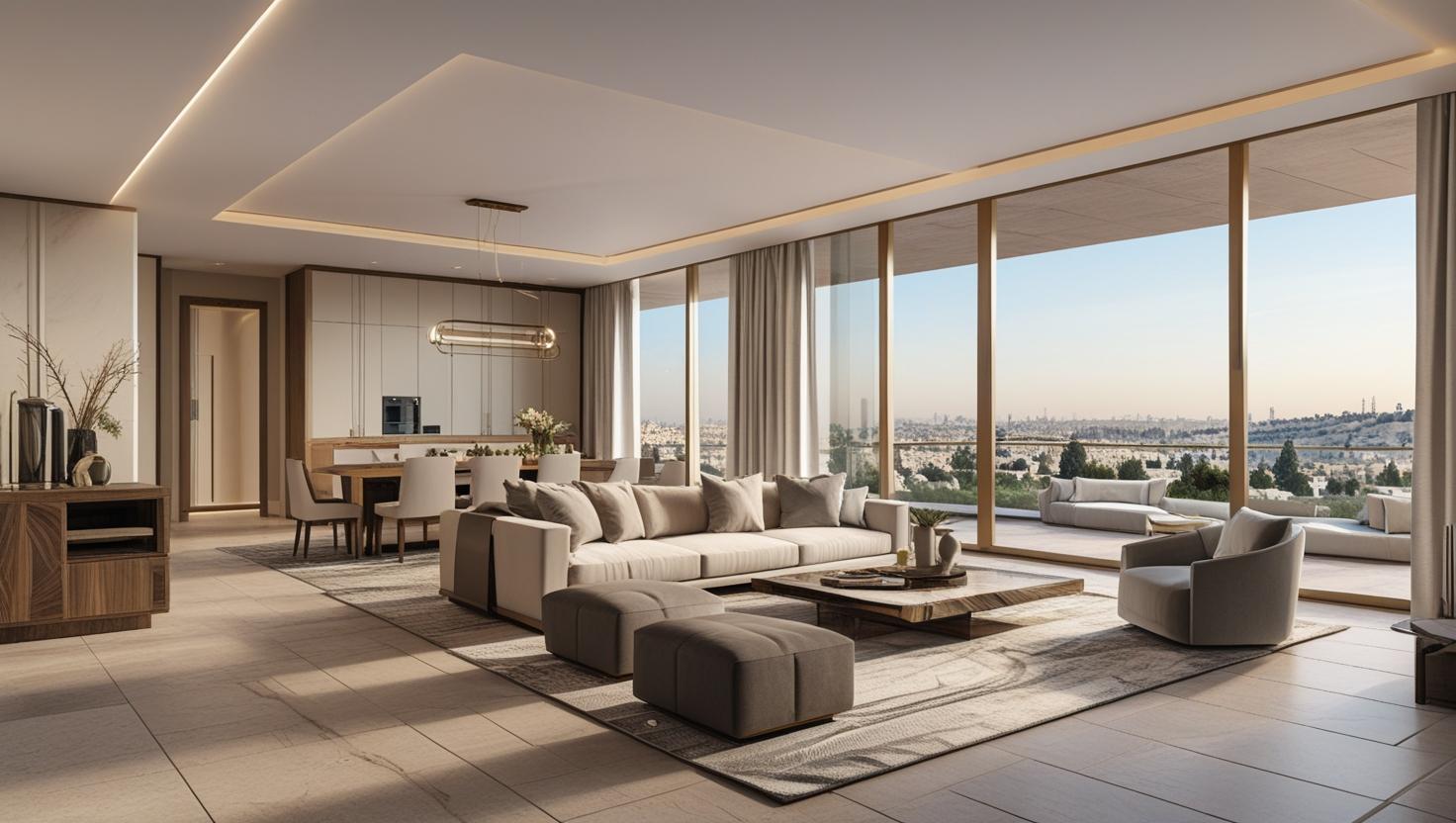
Jerusalem's neighborhoods balance preservation with selective modernization, creating development potential within architectural constraints that enhance scarcity value.
Risk Factors: Why Jerusalem Is Not Risk-Free
Security volatility. Jerusalem remains more exposed to regional tension than Tel Aviv. While 2025 saw a ceasefire hold, any significant deterioration could re-impose a security premium on property values. Investors must accept that geopolitical events create periodic 10-15% corrections. However, over 15-20 year holding periods, institutional anchoring has historically supported recovery.
Liquidity constraints. Tel Aviv's foreign buyer base creates deep liquidity for high-net-worth sellers. Jerusalem's market, while growing, remains shallower. Property holding periods should assume 12-18 months for marketing and closing in Jerusalem, versus 4-8 months in Tel Aviv. This extended exit optionality requires psychological patience and capital that can withstand illiquidity.
Zoning and preservation restrictions. Jerusalem's architectural preservation mandate, while protecting scarcity, also constrains development and flexibility. A ₪10 million villa-lot in Rehavia may not be convertible to multi-unit development or commercial mixed-use—options available in Tel Aviv's zoning framework. This reduces some paths to value creation but reinforces scarcity mechanics.
Shabbat observance dynamics. In some Jerusalem neighborhoods, particularly ultra-Orthodox areas near and around Mea She'arim, Shabbat observance regulations create operational constraints for rental businesses. However, Rehavia, German Colony, Talbiya, and Baka are secular neighborhoods with minimal Shabbat restrictions, making this factor relevant only to neighborhood selection, not to these four aristocratic areas.
The Buyer Profile: Who Moves From Tel Aviv to Jerusalem
Data from Ascend's client portfolio reveals distinct buyer profiles between Tel Aviv and Jerusalem luxury purchasers.
Tel Aviv buyers: 45-55 years old, recent aliyah (immigration) from North America or Western Europe within 2-5 years, primary residence or 3-5 year hold intention, significant concern with year-on-year appreciation and market timing, average holding period 4-7 years.
Jerusalem buyers: 50-65 years old, aliyah 10+ years prior or Israeli-born, multigenerational residence intention (20+ years), low time-preference on appreciation, significant concern with neighborhood cultural fit and institutional proximity, average holding period 15-25+ years.
The technology executive who purchased the Rehavia villa fits the Jerusalem profile precisely: 58 years old, contemplating eventual retirement in Israel, seeking community anchoring in institutional proximity, indifferent to 3-year capital appreciation metrics, oriented toward wealth preservation and income generation rather than speculation.
Buying for 2050 means accepting that your 2026 purchase price becomes irrelevant. What matters is whether the neighborhood's institutional anchors—government, universities, culture—will sustain demand 20 years hence. In Jerusalem's aristocratic neighborhoods, the answer is almost certainly yes. In Tel Aviv's towers? Much less certain.
The Luxury of Depth: Jerusalem's Structural Advantage
Financial theory divides assets into "core" (low volatility, stable cash flows) and "satellite" (high volatility, speculative). Tel Aviv's current market structure optimizes for satellite positioning: capital appreciation drives returns, and hold periods are intentionally short.
Jerusalem's market structure, by contrast, leans core. Lower entry prices + superior rental yields + institutional demand insulation = stable, predictable cash flows. Appreciation becomes secondary.
For investors who have already accumulated wealth and are focused on wealth preservation, lifestyle, and generational anchoring rather than capital accumulation, this core positioning represents a superior framework. The "luxury of depth" is not lavish penthouses or beachfront trophy assets. It's community, cultural significance, intellectual proximity, and the luxury of not caring what the market prices your home at next quarter.
Tel Aviv will continue attracting speculative capital, diaspora wealth seeking to "give back," and investors betting on Israel's entrepreneurship ecosystem. These are rational bets, and Tel Aviv offers legitimate vehicles for these strategies.
But for a subset of sophisticated capital—executives, academics, institutional family offices—Jerusalem's quiet neighborhoods offer something rarer than penthouses: institutional permanence, cultural anchoring, and the mathematics of superior risk-adjusted returns over horizons that matter to people thinking in decades rather than market cycles.
That, finally, is why a Silicon Valley executive chose a Rehavia villa over a Rothschild Boulevard penthouse. Not because Jerusalem is cheaper—it is. Not because the yield spread is statistically significant—though at 110 basis points, it materially compounds. But because, in 2050, when he might be 75 years old reflecting on his life's choices, he wanted to own a home in a neighborhood where decisions were made by judges and professors, not by real estate cycles.
What to Watch: Key Risk Factors
Security escalation. Any major deterioration in ceasefire conditions could reduce Jerusalem's relative attractiveness versus Tel Aviv, which benefits from its distance from border regions. Monitor not just headline security events but also their duration and psychological impact on institutional demand.
Demographic shifts. Jerusalem's institutional base depends on sustained government employment and academic recruitment. Significant government consolidation or university relocations would undermine the structural demand thesis. Current political trends do not indicate such movement, but multi-decade assumptions require monitoring.
Ultra-Orthodox population growth. Jerusalem's ultra-Orthodox population is expanding and moving into previously secular neighborhoods. While not a direct threat to Rehavia, German Colony, Talbiya, or Baka (which remain secular), shifts in neighborhood character could impact rental appeal and long-term desirability.
Transportation infrastructure. The Jerusalem Light Rail and planned bus rapid transit projects are directionally positive for neighborhood accessibility. Their execution timeline and effectiveness will influence appreciation trajectories, particularly for Baka.
Building a Jerusalem Real Estate Strategy
If you're evaluating Jerusalem's neighborhoods for multigenerational wealth anchoring, need guidance on institutional demand patterns, or are reconsidering the Tel Aviv consensus for long-term positioning, Ascend can help. We work with international capital to navigate neighborhood fundamentals, rental market dynamics, and the distinction between speculation and strategic asset allocation in Israeli real estate.
Schedule a ConsultationSources & References
Israel Central Bureau of Statistics Housing Data: cbs.gov.il · Jerusalem Institute Research Publications: jerusaleminstitute.org.il · Bank of Israel Monetary Policy: boi.org.il · TASE Tel Aviv Stock Exchange: tase.org.il · Ministry of Aliyah and Integration: gov.il · Real Estate Market Analysis: Calcalchit · Rental Market Studies: Global Property Guide · Academic Research: Hebrew University Faculty Research